Permanent Lights vs Paying to Hang Lights Every Year: The 5-Year Cost
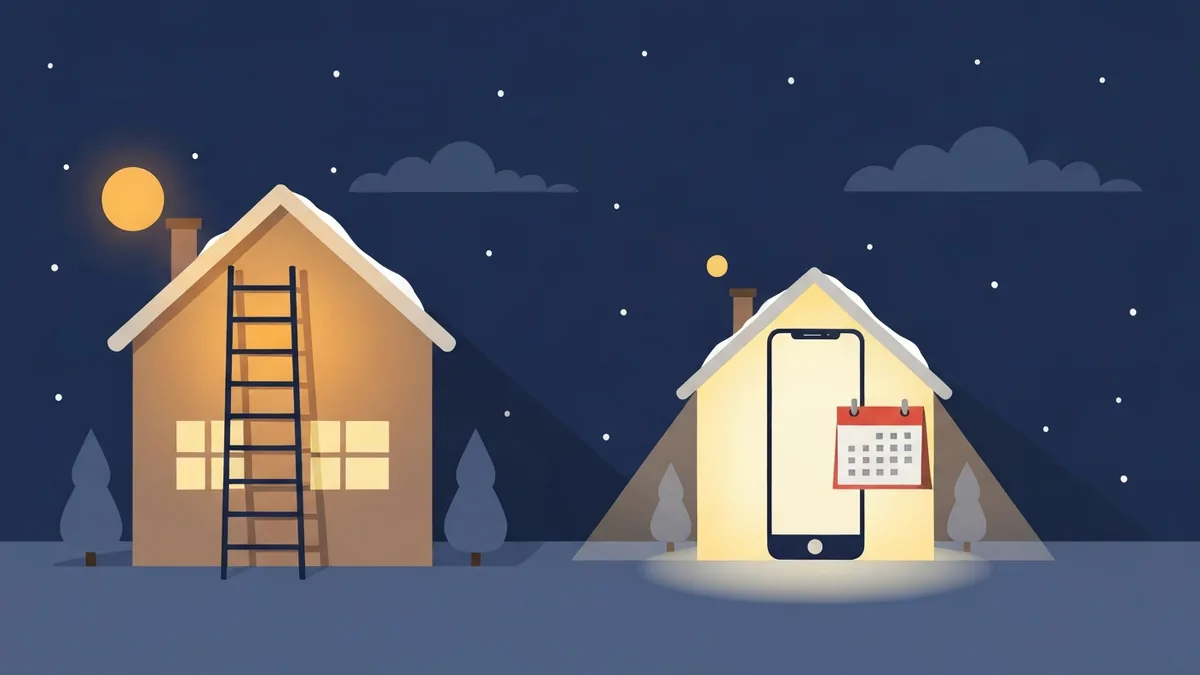
The conversation about permanent outdoor lighting usually starts at the wrong end. Most homeowners look at the upfront cost of a permanent installed system and compare it directly to what they spent last December on lights. That is not the right comparison. The right comparison is what you will spend over five years of annual hanging versus what you pay once for a permanent system. For a mid-size Calgary home, those two numbers are closer than most people expect, and by year four or five they often cross over.
What seasonal hanging actually costs
The true annual cost of temporary holiday lights is easy to underestimate because the expenses arrive at different times and in different forms.
The lights themselves degrade faster than most people plan for. A decent set of outdoor LED strings that will survive a Calgary winter without brittle wire or dead sections runs $80 to $200 per strand at retail. A mid-size two-storey with a full front roofline and a couple of trees typically needs eight to twelve strands for reasonable coverage, putting you at $640 to $2,400 for a proper first setup. Replacement costs in subsequent years are lower, but they are not zero. Connectors corrode, LED segments fail, and strands that go through Calgary’s freeze-thaw cycles a few times start developing dead sections within two to four seasons.
Labour is where the number surprises most people. Hiring a company to hang and remove lights on a typical mid-size Calgary two-storey runs roughly $400 to $800 for installation and $200 to $500 for removal, for a seasonal total of $600 to $1,300 per year before any lights are purchased. On a rental model, where the company owns the strings and you pay by the season, the all-in number typically runs $900 to $1,800 for comparable coverage on a comparable home.
DIY brings the dollar cost down but adds time, storage hassle, and the real physical risk of working from a ladder on ice-covered eavestroughs in late October or November. String lights also need to be coiled carefully, stored dry, and tested before going back up each year. None of that effort accumulates toward anything you own.
Running the five-year math
For a Calgary homeowner who hires the full seasonal service and replaces a portion of their strings every couple of years, a realistic all-in annual spend runs $1,000 to $1,500. Over five years that is $5,000 to $7,500 paid out, with nothing owned at the end except a storage bin of degrading strings that will need attention again next fall.
A HomeOne-grade permanent system installed on a comparable Calgary home typically costs $4,500 to $7,500 all in. That covers the fixtures, the wiring, the controller, and the installation labour. Year two onward, the cost for outdoor lighting is zero.
At the middle of those ranges, the five-year totals are almost identical. For a homeowner spending at the higher end of the annual service model, the crossover can come as early as year three. For someone who hires a crew every year on a larger home, the math tips in favour of permanent well before the five-year mark.
What this comparison does not capture is that the homeowner who goes permanent owns something with real resale value at the end of those five years. The homeowner who keeps renting or re-buying owns nothing.
Calgary winters change the durability math
The freeze-thaw cycle is not obvious when you are buying lights off a shelf in September. In a city with a steady, deep cold, outdoor strings might hold up for four or five seasons with careful storage. Calgary is not that kind of winter.
Chinook systems off the Rockies routinely move the temperature 20 to 30 degrees Celsius in a matter of hours. That cycling is hard on anything with plastic connectors, exposed clips, and wire that gets wet, freezes, and thaws repeatedly through a single season. Strings stored in an unheated garage or shed go through the same cycling even when they are off the roof. It is common for Calgary homeowners to replace more of their seasonal strings more frequently than they expected when they first bought them.
Permanent systems installed at the HomeOne standard use sealed connectors and fixtures rated to minus 40 degrees Celsius. The wiring runs inside protected aluminum channels rather than hanging exposed to weather and wind. The components are also rated for Calgary’s UV load, which is higher than most people realize. Calgary ranks near the top of sunniest-cities lists in Canada, and that UV exposure degrades cheaper outdoor plastics faster than the cold does. A properly specified permanent system handles both the cold and the sun without visible degradation over years of use.
What the math does not capture
A five-year cost comparison makes the financial case, but it leaves out a few things that end up mattering once a permanent system is actually running.
One is time. Getting lights up and down on a two-storey, including ladder setup, diagnosing dead strands, and working around peaks and corners, takes most people a full day each way. Over five years, that is roughly ten full weekend days spent on lighting logistics, not counting the inevitable mid-season troubleshooting when a section goes dark.
The bigger factor is how much more the system gets used when it is always there. Most homeowners plan for Christmas and maybe Canada Day. What tends to happen is the lights run for Halloween in orange and purple, for Flames and Stampeders game nights through the fall, as low-brightness warm white on summer evenings, and as a quiet security presence the rest of the year. The HomeOne app handles scheduling and colour changes without any ladder involved. That year-round use changes the value calculation considerably, and it is something temporary lights cannot offer because they are not there for eight months of the year.
The other factor worth naming honestly is the ladder risk. Hanging lights on a two-storey eave in Calgary in October or November means working at height on a cold surface, sometimes in wind. That risk is real and is not reflected in any cost comparison.
What to know before getting a quote
If you are currently spending somewhere between $800 and $1,500 per year on seasonal lighting, whether through a full-service company, a rental model, or a combination of your own materials and time, the five-year comparison is worth taking seriously.
The upfront cost of a permanent system is real and should be evaluated on your actual home, not on an average. The ranges above give a useful starting frame, but what moves the number is your home’s linear footage, your roofline complexity, and how much of the architectural detail you want to include. A small bungalow and a large two-storey with gable peaks and a triple garage are very different installs.
The other thing worth keeping in mind is that Calgary’s suburban communities vary in age and construction, and that affects the install. Newer vinyl-clad homes in communities like Legacy or Seton tend to have straightforward soffit access. Older homes in established neighbourhoods sometimes have cedar soffits or non-standard fascia profiles that take longer to work around. Neither makes a permanent install impossible, but both can affect where your quote lands within the range.
For a detailed breakdown of the variables that drive the price on a permanent system, the permanent lighting cost guide covers what to expect for different home sizes and roofline types. For the actual number on your home, an in-person measurement is the only way to get something reliable, and that is available at no cost or obligation through the free quote form.