Permanent Outdoor Lighting for Airdrie Homeowners
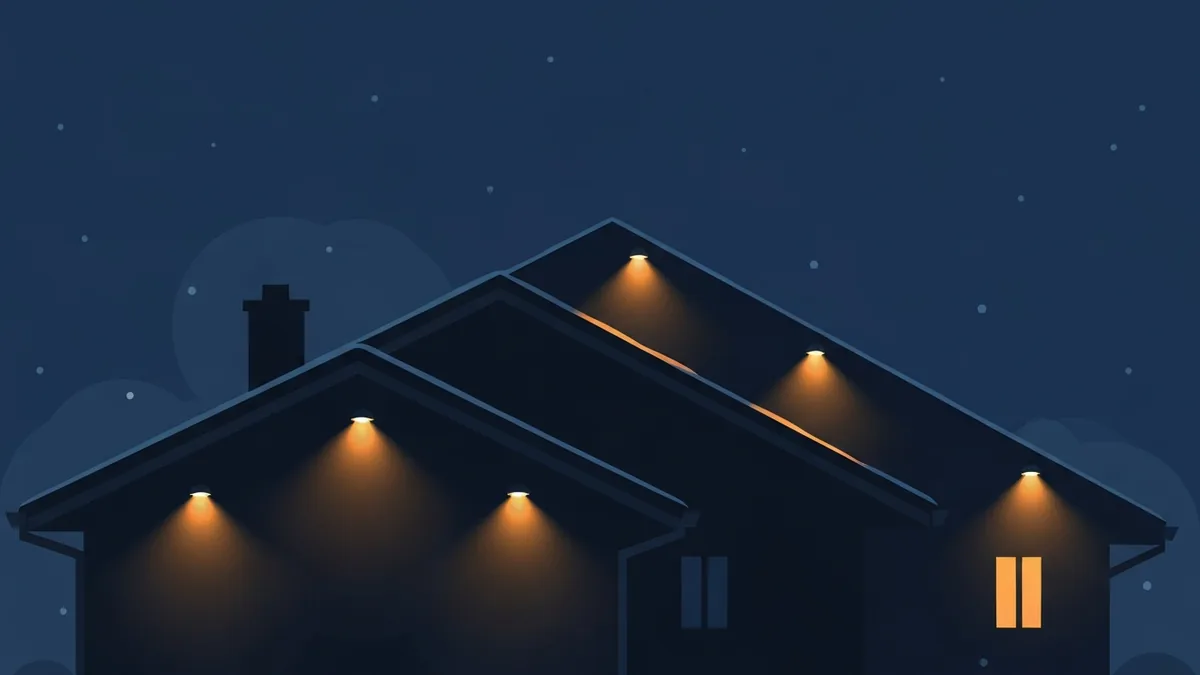
Airdrie has grown quickly over the past two decades, and most of the housing stock reflects it. The newer subdivisions in Coopers Crossing, King’s Heights, Harvestview, and Windsong are full of clean two-storeys and modified bungalows with straight rooflines, attached garages, and well-kept front yards. That kind of architecture is about as compatible with permanent LED lighting as any housing style gets, and it is part of why the finished result tends to look particularly clean on homes in this part of Alberta.
Permanent outdoor LED lighting in this context means something specific: sealed fixtures installed once along your home’s eaves, fascia, and roofline, wired into your home’s electrical, and controlled through a smartphone app. Not seasonal lights left up all year. Not temporary rental lights on a permanent bracket. A system designed from the start to be installed once and used year after year with no seasonal removal, no storage, and no ladder in the driveway every November.
How Airdrie’s climate actually tests outdoor lighting
Airdrie sits on open prairie just north of Calgary, which means it gets the same chinook systems, the same freeze-thaw cycling through winter, and the same high UV exposure year round. The open exposure north of the city means wind-driven snow is more of a factor in some subdivisions than in sheltered Calgary neighbourhoods.
This matters for any outdoor product. Temporary string lights, even the better commercial grades, are not designed for the temperature swings that come with Alberta chinooks. A warm front can push temperatures up 20 to 25 degrees Celsius in a few hours, then drop them again overnight once the dry, cold air returns. Repeated rapidly through a winter, that cycling stresses seals and connections in ways that steady cold does not. It is the oscillation, not the cold floor, that tends to cause failures.
The HomeOne system that AlwaysLit installs is rated to minus 40 Celsius. The fixture channel is low-profile aluminum that mounts flush against the fascia, protected by the eave overhang and clear of the snow loading that hanging or protruding fixtures catch. The wiring runs inside the soffit. The result is a system built for this climate rather than one adapted from a warmer-weather standard.
Calgary and area also ranks among the highest in Canada for annual sunshine hours, including high UV-index days in winter when snow reflection amplifies the exposure. UV degrades outdoor plastics and cheaper fixture housings over time. It matters more across a five to ten year horizon than in year one, but it is a real factor in long-term performance and worth understanding when comparing product grades.
What Airdrie homes tend to look like after installation
Newer construction in Airdrie generally has clean, accessible soffits and consistent eave lines. That makes installation relatively straightforward on most properties, and the finished result tends to be neat. The low-profile channel sits discretely along the roofline, visible when lit and nearly invisible in daylight.
Many homes in communities like Ravenswood, Sagewood, and Morningside were built in the 2000s and 2010s with standard two-storey layouts. These are efficient to install because the roofline is consistent and the linear footage is predictable. Older areas of Airdrie near the original town centre sometimes have more varied architecture, including bungalows with smaller footprints that tend to come in at the lower end of the cost range.
Corner lots are worth noting. They appear throughout Airdrie’s newer planned subdivisions, and some homeowners choose to cover both visible street-facing sides. That adds footage but also adds a lot of visual presence from two directions. Others light only the front-facing roofline and treat the sides as secondary. Both approaches are common and both look intentional.
What people actually use the lights for
The seasonal occasions are obvious: Christmas, Halloween, Canada Day, Remembrance Day. In Airdrie, hockey culture is strong, and Flames or Oilers playoff runs are a popular trigger for red and white displays. The HomeOne app lets you schedule scenes on a calendar, so a hockey night scene can be set once and run automatically without anyone touching the app again.
The more interesting shift for most homeowners is what happens outside of specific occasions. Airdrie evenings in September and October get dark well before 8 pm. Many homeowners find themselves running the system as ambient front-yard lighting well into autumn, something between a porch light and floodlighting that gives the front of the home a calm, lit presence from dusk onward. It is more practical than it sounds until you have it.
Security is a factor too. A home that is regularly lit from outside looks occupied in a way that a dark exterior does not, and that has real value in any neighbourhood regardless of its overall safety level.
What permanent lighting costs in Airdrie
Installed cost depends on the home’s linear footage and roofline complexity, which is why the only reliable number comes from a site visit and measurement. As a rough orientation, smaller Airdrie homes with straightforward rooflines typically land in the $2,500 to $4,500 range. A standard two-storey with reasonable coverage tends to fall between $4,500 and $7,000. Larger homes or those with more architectural detail can go higher depending on how much footage is covered and how accessible the installation points are.
For a thorough breakdown of how the cost is structured and what drives it up or down, the guide to what permanent outdoor lights cost in Calgary covers the components in detail. The pricing reflects the same labour and materials market across the Calgary metro area, including Airdrie.
None of those ranges are fixed. A home with multiple roof levels, dormers, or irregular eave lines takes longer to install and uses more channel material. A straightforward bungalow with two clean rooflines comes in near the lower end. The only useful number is one based on your specific home.
What the installation actually involves
An installation by AlwaysLit typically takes one day on a standard residential property. The installer mounts the fixture channel along the eave, runs weatherproof wiring through the soffit to a connection point, and ties into your home’s electrical panel. On most newer Airdrie homes with accessible panels and standard garage outlets, the tie-in is uncomplicated.
At the end of the day, the installer walks you through the app, shows you how to set scenes and schedules, and leaves you with a working system. There is nothing to test before winter comes, nothing to put away in spring. The system is simply there, ready to use whenever you want it.
For a step-by-step walkthrough of the full process from first contact to finished install, the permanent lighting installation guide explains what happens at each stage.
A note on timing
There is no particular urgency to installing a permanent lighting system, and no honest reason to rush the decision. The system works just as well installed in August as in October. The main practical consideration is that installers across the Calgary area get busier in September and October as homeowners start thinking about Christmas, so booking earlier means more flexibility on scheduling. That is a convenience factor, not a reason to make a decision before you are ready.
For Airdrie homeowners still working through whether this makes sense, the most useful next step is usually a free on-site measurement. That turns the question from an abstract cost comparison into a specific number for your specific home, which is the only version of the number that is actually useful for making a decision.